Showing posts with label Sun. Show all posts

Wednesday, 17 October 2012

Journalism Tips 45. A few #journalism books to try out.


A little break from the finding people posts as in here and here and here. This is an occasional series of books and films the trainee reporter or journalism student may want to try out. No, they are not serious Murdoch-bashing, tabloid-trashing tomes. They are just general reads for the interested and curious reader.
If you want a journalismtip out of this it is... start thinking now about those Christmas stories especially for local newspapers. It comes around pretty quickly and the news editor will be on your case sooner than you think. Make sure the stories will hold... and make sure you can keep your gob shut the next time they scream for a page 43 nib, you could find your Yuletide splash being used as a filler.


1. Waterhouse On Newspaper Style by Keith Waterhouse
Simply brilliant. A classic. Every junior reporter - and indeed quite a few seniors - should have a copy. It was originally written as the style guide for the Daily Mirror (or as he would put it the Daily Mirror style guide) some time in the 1980s.
It's said that copies were photocopied and passed around from journalist to journalist. One day a reporter bumped into Waterhouse and asked him to sign his copy. Realising it was such a popular book he decided to publish it.
The book covers everything you could possibly need to know about writing by a master of his craft.
Revel Barker Publishing. Priced £9.99.
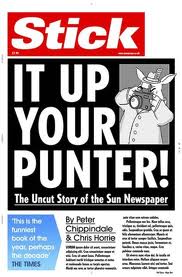

2. Stick It Up Your Punter: The Uncut Story of the Sun Newspaper by Peter Chippendale and Chris Horrie
Entertaining, funny and (for some) shocking all at the same time. Told in a lively way it delves into how the culture at News International developed over time. How investment in its brand of journalism and a swiftness to react made The Sun the country's best-selling tabloid and smashed its once superior rival dominance of the red top market. It may also give you a different perspective on the Wapping industrial dispute. The authors also wrote the equally excellent Disaster: Rise and Fall of News on Sunday - Anatomy of a Business Failure now out of print.
Pocket Books. Priced £7.99.


3. Tickle the Public. One Hundred Years of the Popular Press by Matthew Engel
Very interesting romp through the history of newspapers during the 20th Century. See how British newspaper habits moved from The Times to the Daily Star in a space of a few decades.
And if you think it is no longer applicable, then think again. The title comes from the rhyme popular in Fleet Street in the 19th Century: Tickle the public, make 'em grin, the more you tickle, the more you'll win. Teach the public, you'll never get rich, you live like a beggar, and die in a ditch. (In other words the perfect advice for new web start-ups.)
Now out of print but available on Amazon. Priced £00.01 to £98.27 + p&p.


4. My Trade: A Short History of British Journalism by Andrew Marr
You can't help but feel the Leveson Inquiry could have saved itself a few  weeks of questions if all the lawyers had bought themselves a copy of this enjoyable guide to modern reporting by the BBC's top - and very self-deprecating - interviewer. In a few pages the former editor of the Independent explains why by-lines are so important to reporters, how contacts work, the day to day of newspaper production - and, in particular, his own specialism the lobby - before moving on to how television reporting differs to print. Plus, as the title suggests, there is a wider view on how British newspapers have developed down the years.
Pan MacMillan. Priced £8.99.


5. Shock! Horror! The Tabloids In Action by Sally J. Taylor
It is easy - as well as being very lazy - to think that tabloids just make up all those sensational stories. That is not to say it has never happened but much of it is just down to hard work, dogged determination and (in the old days) very large cheque books being whipped out at just the right time. S.J. Taylor tells some of the stories behind the headlines (to use a cliche).
Now admittedly it has been a few years since I last read this excellent book but S J Taylor has written extensively on newspaper history since then. Particularly about the Daily Mail, An Unlikely Hero: A Newspaper Reborn - Vere Rothermere And How The Daily Mail Was Saved.
Out of print but available on Amazon. Priced £00.01 to £17.00.


To keep up to date with future tips follow @journalismtips on Twitter or sign up below.


Monday, 9 July 2012

Journalism Tips 36. How to get a job as a journalist.

Every year thousands of students graduate from some form of journalism or media course. It makes sense therefore that competition for the few jobs available really must be pretty fierce. Or so you would think.

Actually on the whole it's not particularly competitive because most young trainee reporters cannot be bothered - to rise above the herd really doesn't take very much. These odds are shortened by the growth in traineeships on national newspapers - which Hoover (it's a trademark - hence the cap) up most of the cream of that year's journalism graduates.

That is unfair since I have seen some brilliant - well almost - trainees fail to get one of the coveted places despite having an excellent CV and references...but you see where I am going with this.

Clearly you are the smarter than average trainee/student reporter - how do I know? You are reading this.

So what do you need to do? Well an excellent portfolio helps (more of what I mean by this on a later blog). A devotion to work experience helps also (ditto).

It's often said it is not what you know but who you know that makes a difference. When I started in this industry I didn't know any journalists - but I learned what I needed to know and got to know the people who helped me find work.

Within five years I was talking to former Observer reporter John (There are three rules in journalism. First, find a crocodile. Two, poke it in the eye with a stick. Three, stand back and report what happens next.) Sweeney whose original article on the tabloids - it was written in a fun not pious manner - got me interested in journalism.

A few years on (I was pretty slow) I was working with The Sun's brilliant chief reporter John Kay. It was reading his copy that helped shaped my own (it was never as good).

Each and every opportunity gets developed by experience and your knowledge....unless your parents are execs on a newspaper, in which case forget all I've said.

Some people are naturals most are not...if you're not preparation is the key and this is in part what this blog is all about. Going back to one of the earlier posts you will see that I claim most work experience is a pain in the butt for the majority of news editors. But if a good attitude, decent work ethic and a few stories makes the difference.

It helps also if you can bring new skills to the table but get the old ones first. If you are sent out on a story there's no point getting a first class video if you haven't got the names of the people you're interviewing. You'll note the headline is deliberately geared to SEO - we are all learning new skills, as we shall see in another post that too will prove important as your career progresses.

Given the state of much of the competition you should find a job with two/three months. If you are doing work experience and following this blog (and assuming there is a position available) it shouldn't take even that long. If you are getting lots of stories and the news editor is not rewriting all your copy ask him or her if they know of any jobs around - note not necessarily on their paper. It might even be worth asking for feedback at the end of the week (but be wary news editors put in massively long hours and come the end of the working week are more interested in getting out of the newsroom that sitting talking to the workie).

Again follow up good work experience places with more calls offering stories. Being dynamic and useful are welcome attributes. But make sure you are not the cause of more problems - write the story up so it is ready to go.

Being a pain is more likely to guarantee you won't get an opportunity even if you may have an occasional good idea.

For several months I had one caller who would ask in a vague manner if I'd be interested in certain stories when I asked him to send them over he'd tell me he hadn't written but didn't want to waste his time if I wasn't going to be interested... I took his name and didn't take any more of his calls.

Most of what you do will be a waste of your time. But do enough of it and, not only will you improve as a reporter, it will get you noticed. But, but, but it's got to be to at least to a half-decent standard - again this is something that past and future blogs will cover.

But first and foremost read the papers...you'll be surprised how much you can learn.

To keep up to date with future tips follow @journalismtips on Twitter or sign up below for email updates.


Tuesday, 27 March 2012

31. Sensationalism is rarely sensational, esp in local newspapers. You might get away with it once or twice but not forever.

The trouble most people have with papers like The Sun and formerly the News of the World can be encapsulated in one word: "sensationalism". That and the fact they are read by the working classes...dreadful bunch of people.

The chattering classes can ignore tabloids with a dismissive wave of the hand without ever really looking into them, naturally.


And contrary to what some former tabloid hacks will tell you I never had to make anything up (actually that's a lie I did work for ahem the Sunday Sport - I was young, I was naive, I needed the money, that's usually the excuse...actually I needed the money - and I confess that it is not true that Kangaroos played a football match or Sir Trevor McDonald's face was seen on the White Cliffs of Dover).


But oddly enough, even here I didn't need to make much up. Indeed I learned a lot in how to investigate real - if not particularly edifying - stories on shoestring budgets.


How to track down a Blind Date contestant using their first name, approximate area and clues such as: "I work in a bakery where we make all kinds of bread, if you were a loaf what kind would it be?"


(In my defence here it was the biggest show on television at the time. And I was told to find a story on it once a week. I did. Every week. In the face of the bigger tabloids.)


However the same techniques I learned there - that got me genuine stories - I applied to more productive use years later. Tracing people with few clues and not much of a budget.


The good tabloids do produce sensationalism, if you will, but that is the result of bloody hard work and months of it. And it is only very occasionally wrong. Even the best reporters can make mistakes.


On the whole though I saw a lot of investigation go into stories.


Now compare it to this story. On the face of it the front page headline is correct: Bridport: Pickpockets target market day crowds - enough to scare the wits out of any pensioner.


All well and good until you get to the quotes from anyone in authority who say they have no knowledge of such a crime even taking place. Actually it gets even worse...the purse was found and handed in to the police. Indeed one might wonder why this honesty isn't trumpeted and the answer is lazy journalism and sensationalist reporting. 


Quite frankly it looks ridiculous to almost everyone or just scares naive and gullible local people for no due reason. 


A personal theory is that because local people know their area they will soon know what is and is not true. So while you can get away with such headlines once in a while the cumulative effect is ever diminishing returns. Sales jump up year on year because the news has become so much more racy but like the boy that cried wolf people soon stop paying attention to them in locals.


For once you know someone who is connected to the exaggerated circumstances distrust, like damp in walls, creeps in. Bit by bit the foundations of a local newspaper are undermined and will crumble.


It doesn't help that people will accuse you of sensationalism if they don't like the story as happened in this particular case.


So when tempted to write over blowing the circumstances, taking that top spin a little too hard, just remember you will be caught out. And it won't look good.


Tuesday, 31 January 2012

1. Read a national newspaper at LEAST twice a week – and not just the Guardian or Independent. Try the Mail and Sun as well.

Quite why this has to be stated is beyond me…the fact that it does says a lot about some of the competition (or lack of it) that trainee journalists face. In other words not a lot.

Indeed some have criticised journalismtips for being patronising - oh but I wish it was.

I decided it needed stating after talking to a second year - yes, a second year - journalism student. Having read the first draft of her copy - about a woman celebrating her 100th birthday - I asked her to re-write it into something that resembled newspaper copy.

Five drafts later and I wanted to know what newspaper she read. Her reply was actually more shocking than her copy, "The Guardian" she said with no small amount of pompousness in her voice before adding "...occasionally."

I suggested she might want to broaden her (limited) reading material to include the Daily Mail and The Sun…I may as well have asked her out on a date given the sheer revulsion that spread over her face.

Oddly enough she was unable to fulfill the rest of her week long stint of work experience, which was a relief for all concerned.

What she was doing in a newspaper office was beyond me…more worryingly, what they had been teaching her for the past 18 months was mystifying.

But she was - is - not alone.

So if you want to work in the media (any type of media not just in print) you should be reading national newspapers and not just The Guardian.

To do so is media equivalent of a dietitian only studying the nutritional make-up of muesli and no other foodstuffs on the grounds it is good for you. Yes, it might well be but a mixed diet is healthy and can be fun too.

I say a couple of times a week - I actually mean seven days a week. That's right every day - even at weekends. But, for the sake of form, twice is at least a start.

And please feel free to read the Guardian but make sure you include the Mail and the Sun and the Mirror and the Express and the Times and the Telegraph and the Independent. At £3 a pop you can skip the Financial Times (although it has a very good magazine at the weekend) unless you want to go into financial journalism.

You should be getting a feel for what makes news and the way to do that is by reading an actual newspaper. 

Don't rely on the internet that will only draw you to a few articles you are interested in. So yes, buy the newspaper.