Showing posts with label Times. Show all posts

Wednesday, 17 October 2012

Journalism Tips 45. A few #journalism books to try out.


A little break from the finding people posts as in here and here and here. This is an occasional series of books and films the trainee reporter or journalism student may want to try out. No, they are not serious Murdoch-bashing, tabloid-trashing tomes. They are just general reads for the interested and curious reader.
If you want a journalismtip out of this it is... start thinking now about those Christmas stories especially for local newspapers. It comes around pretty quickly and the news editor will be on your case sooner than you think. Make sure the stories will hold... and make sure you can keep your gob shut the next time they scream for a page 43 nib, you could find your Yuletide splash being used as a filler.


1. Waterhouse On Newspaper Style by Keith Waterhouse
Simply brilliant. A classic. Every junior reporter - and indeed quite a few seniors - should have a copy. It was originally written as the style guide for the Daily Mirror (or as he would put it the Daily Mirror style guide) some time in the 1980s.
It's said that copies were photocopied and passed around from journalist to journalist. One day a reporter bumped into Waterhouse and asked him to sign his copy. Realising it was such a popular book he decided to publish it.
The book covers everything you could possibly need to know about writing by a master of his craft.
Revel Barker Publishing. Priced £9.99.
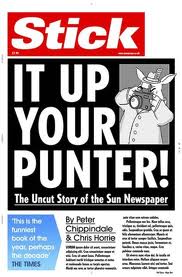

2. Stick It Up Your Punter: The Uncut Story of the Sun Newspaper by Peter Chippendale and Chris Horrie
Entertaining, funny and (for some) shocking all at the same time. Told in a lively way it delves into how the culture at News International developed over time. How investment in its brand of journalism and a swiftness to react made The Sun the country's best-selling tabloid and smashed its once superior rival dominance of the red top market. It may also give you a different perspective on the Wapping industrial dispute. The authors also wrote the equally excellent Disaster: Rise and Fall of News on Sunday - Anatomy of a Business Failure now out of print.
Pocket Books. Priced £7.99.


3. Tickle the Public. One Hundred Years of the Popular Press by Matthew Engel
Very interesting romp through the history of newspapers during the 20th Century. See how British newspaper habits moved from The Times to the Daily Star in a space of a few decades.
And if you think it is no longer applicable, then think again. The title comes from the rhyme popular in Fleet Street in the 19th Century: Tickle the public, make 'em grin, the more you tickle, the more you'll win. Teach the public, you'll never get rich, you live like a beggar, and die in a ditch. (In other words the perfect advice for new web start-ups.)
Now out of print but available on Amazon. Priced £00.01 to £98.27 + p&p.


4. My Trade: A Short History of British Journalism by Andrew Marr
You can't help but feel the Leveson Inquiry could have saved itself a few  weeks of questions if all the lawyers had bought themselves a copy of this enjoyable guide to modern reporting by the BBC's top - and very self-deprecating - interviewer. In a few pages the former editor of the Independent explains why by-lines are so important to reporters, how contacts work, the day to day of newspaper production - and, in particular, his own specialism the lobby - before moving on to how television reporting differs to print. Plus, as the title suggests, there is a wider view on how British newspapers have developed down the years.
Pan MacMillan. Priced £8.99.


5. Shock! Horror! The Tabloids In Action by Sally J. Taylor
It is easy - as well as being very lazy - to think that tabloids just make up all those sensational stories. That is not to say it has never happened but much of it is just down to hard work, dogged determination and (in the old days) very large cheque books being whipped out at just the right time. S.J. Taylor tells some of the stories behind the headlines (to use a cliche).
Now admittedly it has been a few years since I last read this excellent book but S J Taylor has written extensively on newspaper history since then. Particularly about the Daily Mail, An Unlikely Hero: A Newspaper Reborn - Vere Rothermere And How The Daily Mail Was Saved.
Out of print but available on Amazon. Priced £00.01 to £17.00.


To keep up to date with future tips follow @journalismtips on Twitter or sign up below.


Tuesday, 11 September 2012

Journalism Tips 38. How to get a job in journalism: Intros


There are two types of intro: The straight and the dropped. This deals with the former.

Some years ago the Daily Telegraph would boast about the length of its intros - 80-90-100 words plus were, if an exception, not uncommon. Particularly, if memory serves, in its cricket coverage. The writing was, of course, beautifully crafted by professionals at the top of their game... They could get away with it, you cannot.

Like many of the "rules" on the blog this is not hard and fast but a guideline - the problem is not that you occasionally break it but that you break it often.

So if your intros are regularly hitting 30-40 words you are doing something wrong. This really isn't a matter for debate. You are writing for a newspaper not a specialist manual.

Being direct does not mean dumbing down. Nor does it mean - heaven for fend - tabloid. It means being to the point. If it makes you feel any better remember you are part of the Twitter generation (well most of you).

It means that your average reader will be used to 140 character long sentences - including the spaces. That's around 22-24 word mark (I know, I've checked my own Twitter personal account - Anthony_Bonnici if you're interested - and several others, from both tabloid and broadsheet writers - to see how they compare).

So now 25 doesn't seem so bad, does it?

Here's a random example:

Channel 4 has cited concerns over security as the reason for cancelling a planned screening at its headquarters this week of a documentary film questioning the origins of Islam. (29 words)
Guardian

Channel 4 has cited security concerns as the reason for cancelling a planned screening at its headquarters this week of a documentary questioning Islam's origins. (25 words)

Or this from Associated Press (The Americans are masters of the verbose intro as they cram in too much information and reveal very little):

SEATTLE (AP) — Raffaele Sollecito, whose budding love affair with American exchange student Amanda Knox helped land him in an Italian prison for four years, maintains the couple's innocence in a new book but acknowledges that their sometimes bizarre behavior after her roommate's killing gave police reason for suspicion.

So let's look at the facts here:

1. The name: Raffaele Sollecito
2. He was on the verge of a love affair with 
3. Girlfriend's name: Amanda Knox
4. She was an American
5. And an exchange student
6. He was jailed
7. For four years
8. But continues to claim his innocence
9. In a new book
10. He admits their bizarre behaviour was suspicious
11. Amanda Knox's roommate was killed

The problem here is the reporter has not made up his mind what the important facts. And so rather than leaving something out he has put it all in — and that's why the sentence is 46 words long.

Why does it matter? Getting into the habit of tighter sentences is a useful lesson to learn, for a start. Now most "broadsheets" no longer are — they've taken the compact form. Editorial space, especially with ever squeezed budgets, is at a premium.

People's attention spans are certainly not what they were. Think I'm talking about dumbing down... try a copy of The Times, say, 100 years ago... 50 years ago... Hell! Even 20 years ago.


Here's a random article found on the Internet:


No mention of the latest deaths and not a hashtag in sightAs you can see, quite painful. Some might even say it's the future.

Let's put aside the general style and look at the second par.

The coroner for South-West Lancashire opened the inquest on the bodies of those who were killed, but, after taking formal evidence of identification in the case of nine, he adjourned the inquiry until next week. 

A total of 35 words.

Who else was he going to open the inquest for? And for all this we don't know the name of the South-West Lancashire coroner or, indeed, any details of the actual victims of this terrible railway accident.

Someone was clearly being paid by the word (actually they probably were).

Incidentally, seeing as we were talking about intros, this is what the Twitter generation would see:

Yesterday two more victims of the terrible railway accident which occurred on Tuesday evening at Ditton Junction, on the London and North-We

My own efforts for Twitter are this:

Two more people found in the wreckage of the Ditton Junction railway disaster died of their injuries yesterday taking the death toll to 15.

or with hashtags

Two more people caught in the #Ditton Junction #railway disaster wreckage died from their injuries yesterday bringing the death toll to 15.The coroner for South-West Lancashire opened the inquest on the bodies of those who were killed...

I'm sure people could do better.

To keep up to date with future tips follow @journalismtips on Twitter.


The point is lengthy sentences do not necessarily mean serious journalism. It can mean lazy flabby writing.


Ignore all these points if you are being paid by the word.


Tuesday, 31 January 2012

1. Read a national newspaper at LEAST twice a week – and not just the Guardian or Independent. Try the Mail and Sun as well.

Quite why this has to be stated is beyond me…the fact that it does says a lot about some of the competition (or lack of it) that trainee journalists face. In other words not a lot.

Indeed some have criticised journalismtips for being patronising - oh but I wish it was.

I decided it needed stating after talking to a second year - yes, a second year - journalism student. Having read the first draft of her copy - about a woman celebrating her 100th birthday - I asked her to re-write it into something that resembled newspaper copy.

Five drafts later and I wanted to know what newspaper she read. Her reply was actually more shocking than her copy, "The Guardian" she said with no small amount of pompousness in her voice before adding "...occasionally."

I suggested she might want to broaden her (limited) reading material to include the Daily Mail and The Sun…I may as well have asked her out on a date given the sheer revulsion that spread over her face.

Oddly enough she was unable to fulfill the rest of her week long stint of work experience, which was a relief for all concerned.

What she was doing in a newspaper office was beyond me…more worryingly, what they had been teaching her for the past 18 months was mystifying.

But she was - is - not alone.

So if you want to work in the media (any type of media not just in print) you should be reading national newspapers and not just The Guardian.

To do so is media equivalent of a dietitian only studying the nutritional make-up of muesli and no other foodstuffs on the grounds it is good for you. Yes, it might well be but a mixed diet is healthy and can be fun too.

I say a couple of times a week - I actually mean seven days a week. That's right every day - even at weekends. But, for the sake of form, twice is at least a start.

And please feel free to read the Guardian but make sure you include the Mail and the Sun and the Mirror and the Express and the Times and the Telegraph and the Independent. At £3 a pop you can skip the Financial Times (although it has a very good magazine at the weekend) unless you want to go into financial journalism.

You should be getting a feel for what makes news and the way to do that is by reading an actual newspaper. 

Don't rely on the internet that will only draw you to a few articles you are interested in. So yes, buy the newspaper.